
GOOD Company
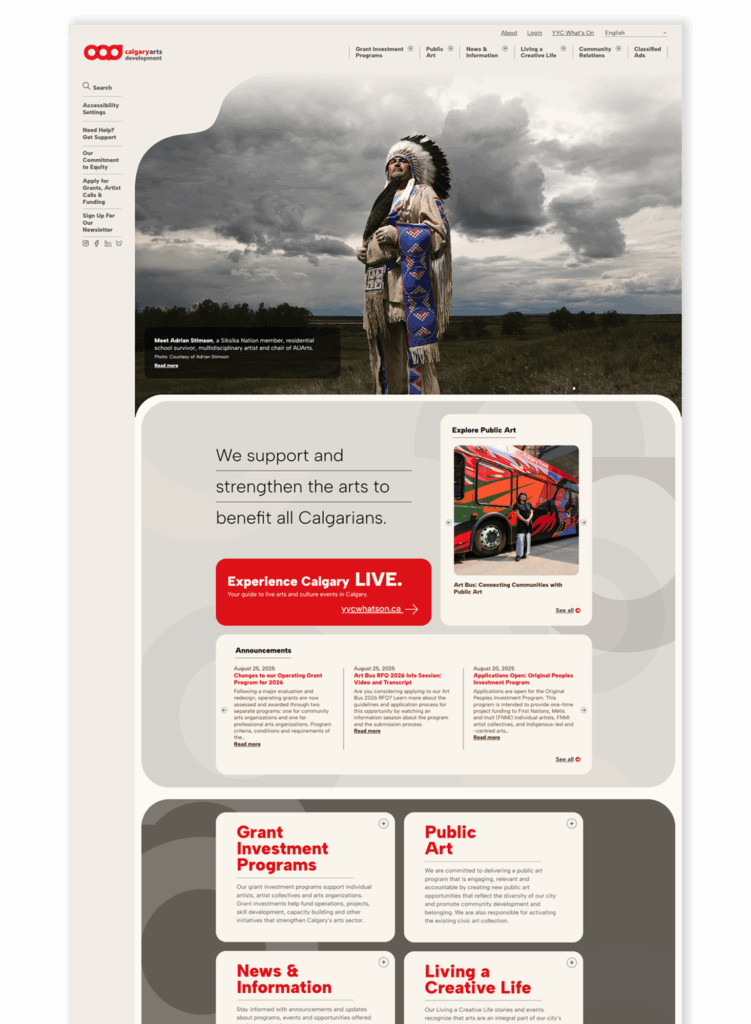
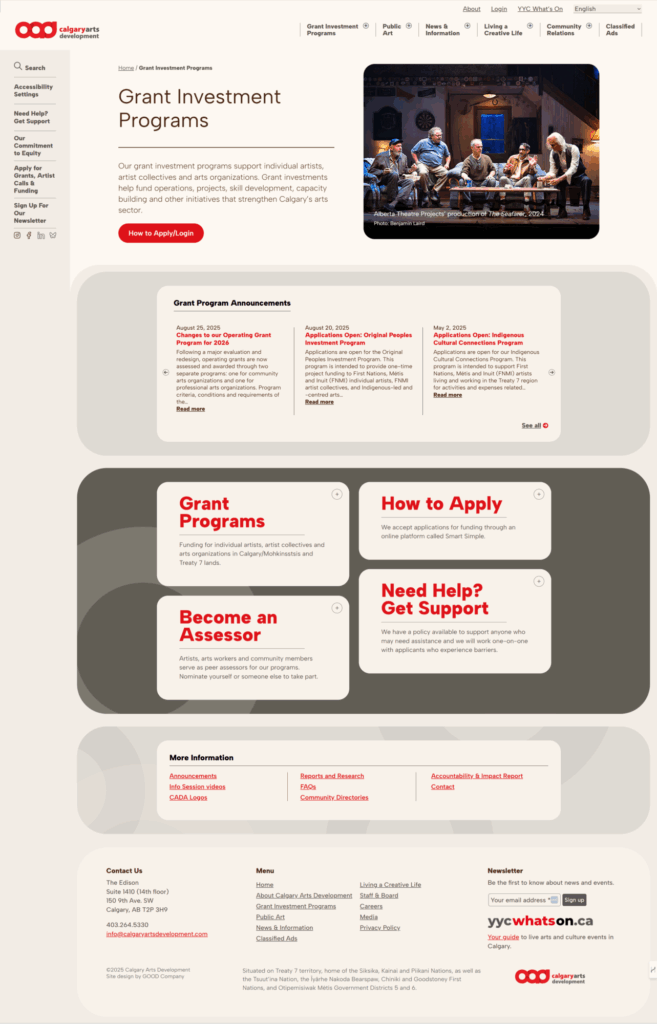
Calgary Arts Development Website
Client: Calgary Arts Development
Credits: Principal and Creative Director: Chris Wharton, Project Manager: Aurélie Chaumeret, Developer: Kier Griffiths
Summary
Calgary Arts Development redesigned its website to enhance accessibility, usability and inclusion, featuring high-contrast modes, text resizing, multilingual support and improved navigation—guided by user feedback and WCAG principles.
Context
Calgary Arts Development is a public arts funder that supports hundreds of artists, artist collectives, and arts organizations through municipal funding. As a steward of public resources, the organization recognized a need to better serve its diverse community with a digital presence that prioritizes inclusion, usability, and accessibility.
The primary goal of the website redesign was to create a more intuitive, welcoming, and equitable online experience. While the previous site met baseline WCAG standards, the organization sought to deepen its commitment to accessibility by embedding those principles throughout the design and content strategy. This included making the site more navigable for people with disabilities, as well as more accessible to users for whom English is not a first language.
Design process
Our process began with a deep listening phase by gathering insights from community stakeholders and Calgary Arts Development staff to understand pain points and user needs. While concept exploration was grounded in visual clarity and content hierarchy, accessibility remained central throughout. We worked closely with an accessibility advisory group and ensured that the site was reviewed by an accessibility hub during both the design and development phases.
We streamlined the site’s structure to make high-priority information easier to access and optimized the navigation and search experience for clarity and efficiency. Planning also took into account the organization’s need to maintain a high volume of frequently updated content, identifying a strategic launch window to ensure continuity for their programming and communications.
Solution
The resulting website offers improved accessibility through a combination of technical, visual, and content-focused enhancements. A redesigned navigation system and advanced search functionality help users quickly locate events, funding opportunities, organizational profiles, and announcements. Forms were rebuilt to streamline applications and submissions, reducing barriers to participation.
Accessibility features such as high-contrast modes, text resizing, and a multilingual interface support a broader range of users. The site’s accessibility was validated through user testing, including input from a Community Working Group on accessibility and feedback from individuals with lived experience. The result is a robust, user-friendly platform that reflects the organization’s values and ongoing commitment to equitable access.
Accessibility features such as high-contrast modes, text resizing, and a multilingual interface support a broader range of users.
Which fundamentals of accessible design were considered?
The site was developed in alignment with the four key principles of the Web Content Accessibility Guidelines (WCAG): perceivability, operability, understandability, and robustness. We ensured that all content could be accessed and understood by users with various visual, cognitive, and physical abilities. This included alternative text for images, semantic HTML, keyboard operability, and clear language throughout.
Navigation and page layouts were designed to be intuitive, with consistent structure and visual cues that do not rely solely on color to convey information. The high-contrast mode and text resizing features allow for additional personalization based on user needs. All components were tested for compatibility with screen readers and assistive technologies.
Does the project reflect the principles of diversity and inclusion? If so, explain.
Yes, diversity and inclusion were integral to both the design and the process. Calgary Arts Development’s work serves a broad cross-section of communities including Indigenous artists, newcomers, Deaf and disabled artists, and those working in languages other than English. The site reflects this diversity through multilingual capabilities, accessible visual systems, and inclusive content design.
Importantly, we collaborated with a dedicated EDIA Community Working Group who provided feedback throughout the project. Their insights helped shape decisions related to language, imagery, and functionality, ensuring that a variety of lived experiences were considered. This collaborative and responsive approach positioned accessibility not as a checklist, but as an essential part of an equitable and inclusive digital environment.